How much marshmallow root is in Nerve Fresh?
Each two-capsule serving of Nerve Fresh lists 220 mg of marshmallow root powder, from Althaea officinalis. It is the second-largest ingredient, about 23% of the 960 mg serving.
Marshmallow here is the plant, not the sweet. The white confection was once made from the plant's root but is now mostly sugar. The label calls the ingredient "Marshmallow Root Powder (Althaea officinalis)" and gives no % Daily Value. Our supplement facts page shows it in the context of the full panel.
| Detail | What the label or sources say |
|---|---|
| Amount per serving | 220 mg of root powder (label) |
| Share of the serving | About 23% of 960 mg (our arithmetic) |
| Plant | Althaea officinalis |
| General safety | Generally considered safe; likely safe by mouth for most people |
| Main caution | May slow absorption of other medicines taken at the same time |
| Blood sugar | May lower it, especially with diabetes medicines |
| Listed interaction | Lithium |
What is marshmallow root used for?
Marshmallow has been used for more than 2,000 years as a food and a medicine, mainly as a soft, slippery coating for the mouth, throat and stomach.[1] That coating quality comes from mucilage, a gel-like fiber in the root.
Nothing in our sources links marshmallow root to nerve symptoms. Its role in a nerve-themed blend is not explained on the label or the sales page, and we will not guess. What its coating quality does explain is the caution that matters most for anyone who takes daily medicines, set out below. For what the evidence says about all five plants, see our evidence page.
Why does marshmallow root matter if I take other medicines?
Because it coats the lining of the stomach, marshmallow may interfere with how other drugs or herbs are absorbed. Mount Sinai's health library advises taking marshmallow several hours before or after other herbs or medicines.[1]
This is a practical timing issue rather than a toxic one, but it can matter a great deal for medicines that need a steady level in the blood. If a medicine is absorbed less well, it may simply work less well. The label's directions say only "two capsules daily", so spacing them from your other pills is something to plan with your pharmacist.
- Write down every medicine you take by mouth and when you take it.
- Ask your pharmacist how many hours to leave between them and the capsules.
- If a medicine must be taken at a fixed time, schedule the capsules around it, not the other way round.
- Keep the same routine every day so your levels stay steady.
Our how to use page shows how to fit two capsules into a day with other medicines.
Can marshmallow root lower blood sugar?
It might, in some people. RxList notes that marshmallow might cause low blood sugar levels and advises people with diabetes to check their blood sugar carefully.[2]
Mount Sinai lists diabetes drugs as an interaction for the same reason: taking them with marshmallow may make blood sugar go too low.[1] Nerve Fresh also contains prickly pear, which has its own blood sugar caution, so two of the five ingredients point the same way. If you take insulin or another medicine that lowers blood sugar, talk to your doctor before you start, and check your sugar more often in the first weeks. Our blood sugar page explains the signs of a low.
Does marshmallow root interact with lithium?
A lithium interaction is listed. Mount Sinai's health library says marshmallow may increase the amount of lithium in the body, which can raise the risk of side effects.[1]
Lithium has a narrow safe range, so any change in its level matters. If you take lithium, do not start Nerve Fresh without asking the doctor who prescribes it. Our medicines page has a question builder that writes the question for you.
Is marshmallow root safe in pregnancy?
On its own, marshmallow appears to be safe in pregnancy and breastfeeding, according to Mount Sinai, which still advises checking with your doctor first.[1] Nerve Fresh as a whole is a different matter.
The product contains corydalis, which is listed as unsafe in pregnancy, and passionflower, which NCCIH has advised against in pregnancy. The label asks pregnant or nursing mothers to consult a physician. So marshmallow root is not the concern here; the blend is. Our pregnancy and nursing page sets out each caution.
What side effects are linked to marshmallow root?
Very few. Mount Sinai says marshmallow has no reported side effects and is generally considered safe, and RxList rates it likely safe by mouth for most people, with the low blood sugar caution noted above.[2]
An allergy to any plant is always possible, and the label's allergen line covers the facility rather than the herbs. If you notice a rash, swelling or trouble breathing after a dose, stop and get medical help. Our side effects page lists what to watch for with the whole blend, and our safety page explains when to stop.
How do I fit marshmallow root around other medicines?
Build a simple daily schedule with your pharmacist, leaving a gap of several hours between the capsules and any medicine that needs to be absorbed well. Mount Sinai's advice is to take marshmallow several hours before or after other herbs or medicines.[1]
The label says only "two capsules daily", and the seller's notes add "with food", so there is room to choose the time. Here is one way people organize it, to be checked with a pharmacist before you use it:
| Time | What goes here |
|---|---|
| On waking | Medicines that must be taken on an empty stomach |
| Breakfast | Morning medicines with food |
| Lunch | Two Nerve Fresh capsules with food, if your pharmacist agrees |
| Evening meal | Evening medicines |
| Bedtime | Medicines your doctor wants at night |
The point is not the exact times but the gap. If your doctor checks blood levels of any medicine, tell them you have started a product that contains marshmallow root, so they can judge whether a change in a result is linked. Our how to use page has more on daily routines. If you take a medicine only once a week, or one that is timed around meals, ask the pharmacist to mark the gap on the medicine's own instructions so you do not have to remember it.
What we could not confirm about the marshmallow root in Nerve Fresh
We could not confirm where the root comes from, whether it is peeled or unpeeled, or whether the powder is tested for purity. The label gives the plant name, Althaea officinalis, and the amount, 220 mg, and nothing more.
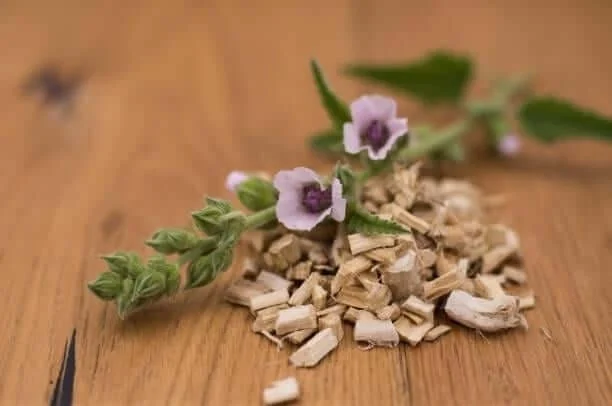
That is common for herbal powders, but it is still a gap. NCCIH points out that what is in a supplement bottle can differ from what is on the label, and that it is worth asking a seller for proof of quality.[3] The FDA does not approve supplements before they are sold, so testing is up to the maker.[4] The photo the seller supplied shows a marshmallow plant with pale flowers and chopped dried root, which matches the ingredient. If you want more certainty, ask the order desk for a certificate of analysis for your lot, and compare your bottle with the checklist on our bottle check page.
Why would a nerve-themed product contain marshmallow root?
The label does not say, and neither does the sales page in any way we could check. Marshmallow root's traditional uses are for the mouth, throat and stomach, where its gel-like fiber forms a soft coating, not for nerves.
We will not invent a reason. What we can say is what its presence means in practice. Marshmallow root is the second-largest ingredient, and its main caution, slower absorption of other medicines, applies to the people most likely to buy a nerve product: adults who often take several daily medicines. That makes it more important, not less, than its gentle reputation suggests. It also shares a possible blood sugar effect with prickly pear, so the product carries two small nudges in the same direction for anyone with diabetes.
Here is how marshmallow root compares with the other four ingredients on the two cautions that apply to it:
| Ingredient | May slow other medicines | May lower blood sugar | Linked with drowsiness |
|---|---|---|---|
| Marshmallow root | Yes (Mount Sinai) | Yes (RxList, Mount Sinai) | No |
| Prickly pear | Not in our sources | Yes (Mayo Clinic, RxList) | No |
| Passionflower | Not in our sources | Not in our sources | Yes |
| Corydalis | Not in our sources | Not in our sources | Yes |
| California poppy | Not in our sources | Not in our sources | Yes |
If you take any medicine where steady absorption matters, or any medicine that lowers blood sugar, the conversation with your pharmacist should start with this ingredient. Our ingredients page covers the rest of the panel, and our evidence page explains what has been studied.
Frequently asked questions
Is marshmallow root the same as the marshmallow sweet?
No. The ingredient is the root of the Althaea officinalis plant. Modern sweets are made mostly from sugar.
How far apart should I take Nerve Fresh and my pills?
Ask your pharmacist. Mount Sinai advises several hours between marshmallow and other medicines, and the right gap depends on the medicine.
Does marshmallow root in Nerve Fresh contain sugar?
The label lists 220 mg of root powder and no sugar line. It is a plant powder, not a confection.
Should I tell my doctor about marshmallow root if I have diabetes?
Yes. It may lower blood sugar, and so may the prickly pear in the same capsules.
Is marshmallow root a filler?
No. It is listed as an active ingredient with an amount. The capsule ingredients are listed separately as other ingredients.
Medical review: Dr. Mark Runkle, DPM, Physician. Named in the owner-supplied pack as the reviewer; this is not independently verified and is not an endorsement. Safety lines also cite NIH, FDA, Poison Control and FTC pages. How review works.
Sources
- Mount Sinai Health Library: Marshmallow. www.mountsinai.org
- RxList: Marshmallow. www.rxlist.com
- NCCIH: Using Dietary Supplements Wisely. www.nccih.nih.gov
- FDA: FDA 101: Dietary Supplements. www.fda.gov
Safety: Nerve Fresh Capsules is a dietary supplement, not a medicine, and not a neuropathy medicine. Follow your bottle's label (two capsules a day). Three of its five herbs (passionflower, corydalis, California poppy) can cause drowsiness: do not drive until you know how it affects you, avoid alcohol and other sedating products with it, and do not stop or change a prescribed nerve, sleep or anxiety medicine on your own. Liver injury has been reported with corydalis; stop and call a doctor if you notice dark urine, yellow skin or eyes, or upper belly pain. Prickly pear and marshmallow may lower blood sugar. Not for pregnancy, nursing or anyone under 18; ask your doctor first if you take any medicine, have a liver condition or diabetes, or have surgery planned.
Inervefresh is an independent information site, not the manufacturer of Nerve Fresh Capsules. We may earn from order links on this site; order links are marked sponsored. *These statements have not been evaluated by the Food and Drug Administration. This product is not intended to diagnose, treat, cure or prevent any disease. Page updated November 26, 2026.