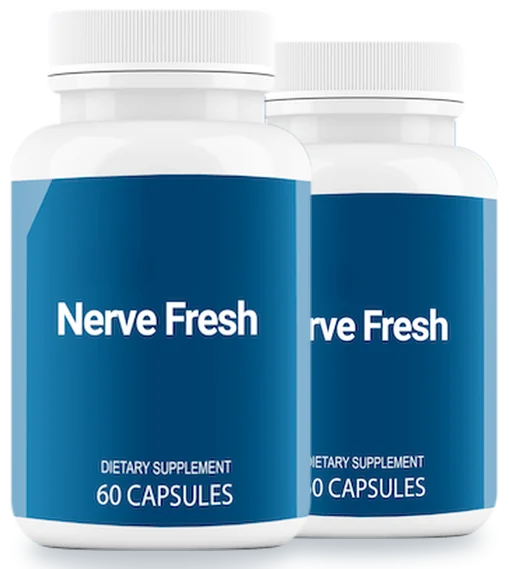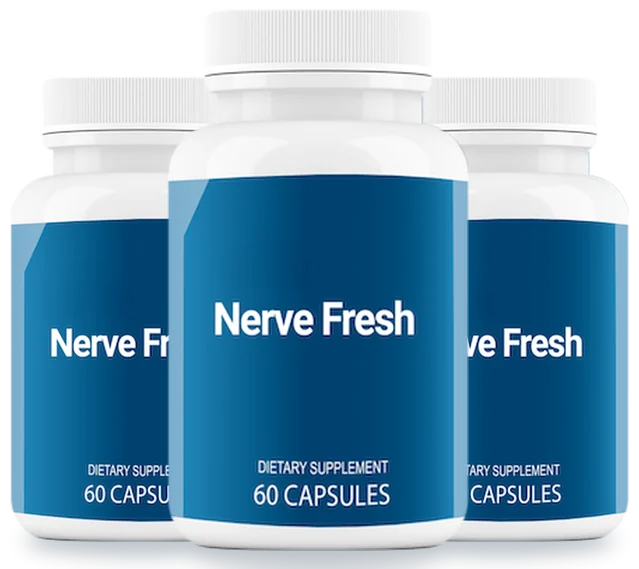
What does the Nerve Fresh bottle itself claim?
The bottle claims almost nothing. The front says "Nerve Fresh", "Dietary Supplement" and "60 Capsules", and the side panels carry directions, cautions, the panel and the FDA statement, with no claim about nerves, pain or any body function.
That is worth knowing because the sales page and the seller's badges say much more. Under federal rules, a supplement label may carry a structure or function claim, such as a statement about how an ingredient affects the body, but it must then carry the FDA disclaimer and may not claim to "diagnose, treat, cure or prevent" a disease.[1] The Nerve Fresh label prints the disclaimer while making no such claim, which is the most cautious position a label can take. Everything else on this page comes from outside the bottle.
 “Good Manufacturing Practice · GMP”
 “GMO Free”
 “Manufactured in the USA”
 “No Fillers”
 “No Stimulants”
 “No Tolerance Forming”
Badges supplied by the seller, quoted as printed. None is on the bottle label, and no certificate or test came with them. "No Fillers" sits beside a label that lists microcrystalline cellulose, magnesium stearate and silica. What each badge would need to mean.
What do the six seller badges say?
The seller supplied six round badge images: a "Good Manufacturing Practice · GMP · Consistent Quality" seal, a "GMO Free" seal, and badges reading "Manufactured in the USA", "No Fillers", "No Stimulants" and "No Tolerance Forming". None appears on the label image.
We show them because the seller uses them, quote them exactly as printed, and mark every one unverified. No certificate, test report or audit came with any of them. The table below sets out what each would need to mean, and what we could check against the label.
| Badge (as printed) | What it would need | What we could check |
|---|---|---|
| "GMP · Consistent Quality" | A named facility and an audit or certificate | None supplied; CGMP is a legal minimum for all makers |
| "GMO Free" | Testing or a named certification | None supplied |
| "Manufactured in the USA" | All or virtually all of the product made in the US | Label says "Distributed by" with no origin statement |
| "No Fillers" | No bulking or flow agents | Label lists microcrystalline cellulose, magnesium stearate, silica |
| "No Stimulants" | No stimulant ingredients | None listed; badge unverified |
| "No Tolerance Forming" | A study showing no loss of effect or dependence | None supplied |
What does a "GMP" seal really mean?
It means very little on its own, because every supplement maker selling in the United States must follow the FDA's current manufacturing-practice rules for supplements, known as CGMP. A seal says the maker is meeting a legal floor, not winning an award.
The Defense Department's Operation Supplement Safety warns that seals with words such as "Certified GMP" or "FDA approved facility" should not be mistaken for signs of safety or federal approval.[2] A "GMP" claim becomes meaningful when it names the facility and an independent auditor, and when the seller can show the certificate. Neither was supplied here. If you want assurance about manufacturing, ask the seller for the name of the facility and a certificate of analysis for your lot.
Does "FDA registered" mean "FDA approved"?
No. Facilities that make food and supplements must register with the FDA, but registration is a listing, not an approval. Federal regulations state that a registration number does not convey FDA approval or endorsement of a facility or its products.[3]
The FDA itself says that mere registration of an establishment does not denote approval of the establishment or its products.[4] The sales material for this category often uses phrases like "FDA registered facility" in a way that sounds like approval. It is not. The FDA does not approve supplements for safety or effectiveness before they are sold, and the Nerve Fresh label says so in its own FDA statement.
Is "Manufactured in the USA" correct?
We cannot tell. The badge says "Manufactured in the USA", but the label image says only "Distributed by: Nerve Fresh, Miami Beach, FL" and gives no country of manufacture or ingredient origin.
The FTC's standard is strict: an unqualified "Made in USA" claim means all or virtually all of the product, including its ingredients, is made in the United States.[5] Herbs such as corydalis, a traditional Chinese plant, are often grown abroad, so a qualified statement might be more accurate. We have asked the site owner to name the manufacturer and confirm the origin of the ingredients. Until then, the badge stays marked unverified.
Is "No Tolerance Forming" a safety guarantee?
No. It is a claim with no test behind it that we could see. It suggests the product will not lose its effect over time or create dependence, but no study of Nerve Fresh was supplied, and none appears in our sources.
The wording deserves care because three of the five herbs are calming herbs. Our sources do not describe passionflower, corydalis or California poppy as habit-forming, but they also do not test the long-term use of this blend. NCCIH notes that passionflower's daily use as an extract may be safe for up to eight weeks, which says nothing about longer use.[6] If you take the capsules for months, review them with your doctor rather than relying on a badge.
What does the sales page claim that we never repeat?
The sales page uses a headline with "Ditch Gabapentin" and "Reverse Neuropathy Damage", a "9-Second Trick", and "risk free" wording. We do not repeat those claims as our own, and we quote them here only so you can recognize them.
Each one is a problem. Advice to drop a prescription medicine is dangerous; only the prescriber should change it. Claims to "reverse" nerve damage are disease claims that a supplement may not make. A "trick" is a sales hook, not a method, and "risk free" ignores the drowsiness and liver cautions this site documents. The FTC says health claims must be backed by competent and reliable scientific evidence, and testimonials do not count as that evidence.[7]
- Never stop or cut a prescribed medicine because of an advertisement.
- Read any promise to "reverse" or "repair" nerves as unsupported.
- Ignore countdowns, "today only" offers and crossed-out prices.
- Ask who the named "specialist" is and whether you can verify them.
Ad-claim decoder
ToolSaw an ad for these capsules or a look-alike? Pick a sample or type the claim. The decoder compares it with FDA and FTC rules and with what the bottle label actually lists.
How should I use the badges when deciding?
Give them no weight until the seller shows the papers behind them. Base your decision on the label, the cautions in the cited sources, your own health and a conversation with your doctor or pharmacist.
If a seller can produce a certificate for a manufacturing audit, a certificate of analysis for your lot and a clear statement of where the product was made, those are worth having, and we will update this page when they arrive. Until then, the most reliable document is the bottle label, and the most reliable advice is your own clinician's. Our legit page collects every check in one place, our supplement facts page explains the label, our capsule ingredients page looks at the "No Fillers" conflict, and our safety page explains the cautions the badges leave out.
What is a structure or function claim?
A structure or function claim describes how an ingredient affects the normal structure or working of the body, without naming a disease. Supplements may make such claims, but only with the FDA disclaimer and only if the claim is truthful and supported.
The FDA explains that a manufacturer making a structure or function claim must have substantiation that it is truthful and not misleading, must include the disclaimer that the FDA has not evaluated the claim, and must notify the FDA within 30 days of marketing it.[1] A claim that a product helps a disease, such as neuropathy, crosses into a drug claim, which a supplement may not make. The Nerve Fresh bottle avoids the problem by making no claim at all; the sales page does not.
| Kind of statement | Example wording | Allowed for a supplement? |
|---|---|---|
| Ingredient fact | "Passion flower herb powder, 350 mg" | Yes |
| Structure or function claim | A statement about normal body function, with the FDA disclaimer | Yes, if truthful and supported |
| Disease claim | "Reverses neuropathy damage" | No |
| Medicine advice | "Ditch your prescription" | No, and dangerous |
| Endorsement | A named doctor or specialist | Only if real and verifiable |
The FDA disclaimer printed on the bottle, and in the footer of this site, exists because of these rules.
Why do badges matter if they are not on the label?
Because buyers often take a row of round seals as proof of quality, and the seals in this category are usually images, not certifications. Seeing six badges next to a product can create confidence that the documents do not support.
The FTC holds sellers responsible for the overall impression an ad creates, not just the literal words, and expects claims about quality or origin to be backed by evidence.[7] A badge that conflicts with the label, as "No Fillers" does here, is a reason to give the others less weight until the seller produces papers. We will keep showing the badges, quoted and marked unverified, so you can see what the seller says. We will not let them stand in for evidence.
- Look for the same claim on the bottle label itself.
- Ask for the certificate, the auditor's name and the date.
- Check that the certificate covers this product and this facility.
- Be wary of any badge that conflicts with the ingredient list.
Frequently asked questions
Are the Nerve Fresh badges printed on the bottle?
No. They are separate images supplied by the seller. The label image shows none of them.
Does Nerve Fresh have an FDA approval?
No supplement does. The FDA does not approve dietary supplements before sale, and the label prints the FDA statement saying so.
Why does the "No Fillers" badge conflict with the label?
Because the label lists microcrystalline cellulose, magnesium stearate and silica, which bulk and help powder flow, the job most people mean by filler.
Can a seller call a product "GMP certified" without proof?
Every maker must follow CGMP rules, so the phrase adds little. A meaningful claim names the facility and an independent auditor.
Will you update the Nerve Fresh badge notes if the seller sends certificates?
Yes. We will show what each certificate covers, with its date, and change the badge status where it is supported.
Medical review: Dr. Mark Runkle, DPM, Physician. Named in the owner-supplied pack as the reviewer; this is not independently verified and is not an endorsement. Safety lines also cite NIH, FDA, Poison Control and FTC pages. How review works.
Sources
- FDA: Structure/Function Claims. www.fda.gov
- Operation Supplement Safety (DoD): CGMP/GMP seals: what do they mean?. www.opss.org
- 21 CFR § 1.242: What does assignment of a registration number mean?. www.law.cornell.edu
- FDA: Is It Really "FDA Approved"?. www.fda.gov
- FTC: Complying with the Made in USA Standard. www.ftc.gov
- NCCIH: Passionflower. www.nccih.nih.gov
- FTC: Health Products Compliance Guidance. www.ftc.gov
Safety: Nerve Fresh Capsules is a dietary supplement, not a medicine, and not a neuropathy medicine. Follow your bottle's label (two capsules a day). Three of its five herbs (passionflower, corydalis, California poppy) can cause drowsiness: do not drive until you know how it affects you, avoid alcohol and other sedating products with it, and do not stop or change a prescribed nerve, sleep or anxiety medicine on your own. Liver injury has been reported with corydalis; stop and call a doctor if you notice dark urine, yellow skin or eyes, or upper belly pain. Prickly pear and marshmallow may lower blood sugar. Not for pregnancy, nursing or anyone under 18; ask your doctor first if you take any medicine, have a liver condition or diabetes, or have surgery planned.
Inervefresh is an independent information site, not the manufacturer of Nerve Fresh Capsules. We may earn from order links on this site; order links are marked sponsored. *These statements have not been evaluated by the Food and Drug Administration. This product is not intended to diagnose, treat, cure or prevent any disease. Page updated November 26, 2026.